


Fossils in Museums: How to Separate Observation From Interpretation
Fossils in Museums: How to Separate Observation From Interpretation
A fossil is already interesting before anyone tells you what it means.
A trilobite, dinosaur bone, fish, leaf impression, trackway, shell bed, or articulated skeleton is physical evidence that an organism lived and that some sequence of events preserved part of it in sediment or rock. The fossil is real. Its anatomy is real. Its location and stratigraphic position are real.
The larger historical story comes next.
That distinction is especially useful in a museum, where a small label may move quickly from describing a specimen to placing it within millions of years of geological history and an evolutionary lineage. A Christian visitor does not need to dismiss the specimen because of the interpretation, and should not pretend the interpretation appeared from nowhere. The better question is how the conclusions were built from the evidence.
Preservation Is Part of the Evidence
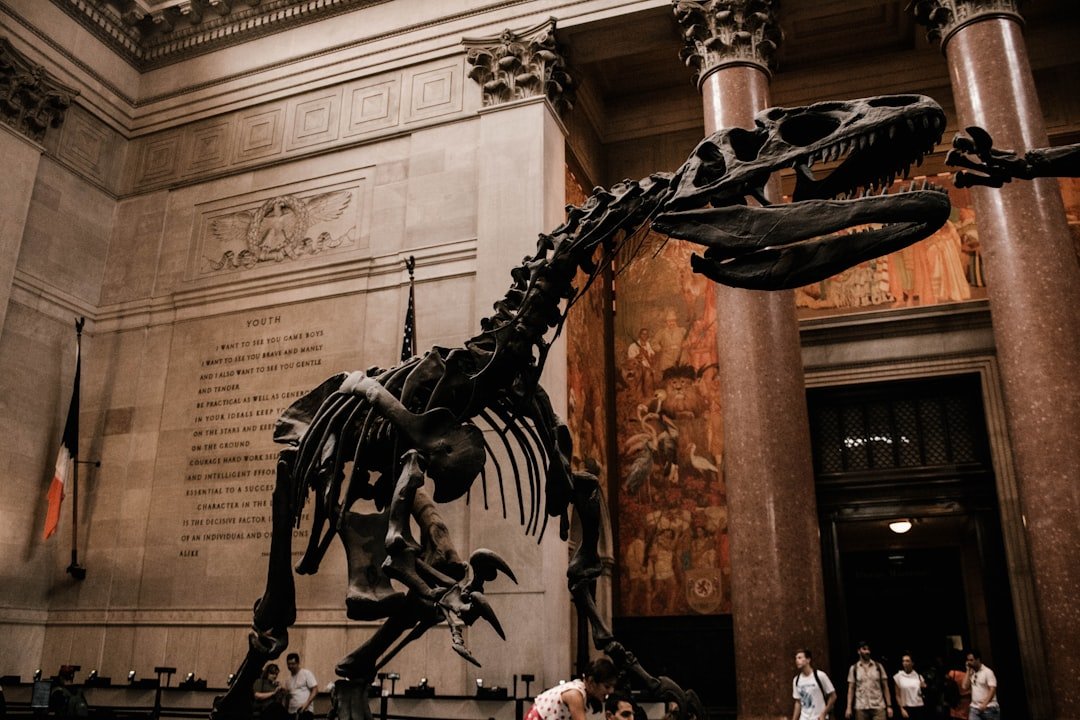
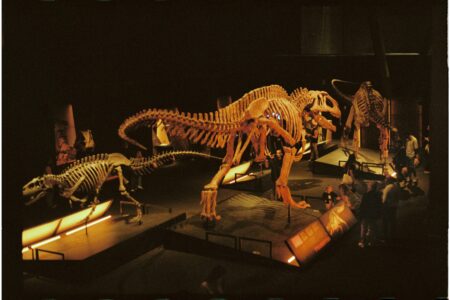
Begin by asking what is actually preserved. Is the display a complete skeleton, a few bones, a shell, an impression, a track, a cast, or a reconstruction assembled from several specimens? Mounted skeletons often contain a mixture of original fossil material, casts, and reconstructed portions. That is normal museum practice, but it matters if you want to know how much of the animal is directly known.
Then look at preservation itself. Most dead organisms do not fossilize. They decay, are eaten, scattered, weathered, or broken apart. A fossil therefore raises immediate questions about burial and environment.
Is the skeleton articulated? Are delicate structures preserved? Was the specimen transported? Are many organisms concentrated together? What kind of sediment surrounds it? A shell in limestone, a tree trunk in sandstone, and a fish in fine laminated sediment are not the same preservational problem.
Conventional paleontology readily recognizes storms, volcanic events, debris flows, rapid burial, mass mortality, and other catastrophic processes in particular deposits while placing those events inside a much longer geological timescale. Young-earth creation models give catastrophic sedimentation a much larger role in the overall fossil record, especially in connection with the Flood.
The useful question at the museum is not “Was this catastrophic?” in the abstract. Ask what the individual specimen and its deposit actually require.
The Fossil Record Has Patterns Any Model Has to Explain
Different fossil groups occur in a broadly consistent stratigraphic order. That is one of the major observations in paleontology, and a creation model has to take it seriously.
Conventional geology interprets that order primarily through deep time, environmental change, evolution, extinction, and successive sedimentary environments. Young-earth creation models have explored ecological zonation, geographic distribution, mobility, hydrodynamic processes, progressive burial, and catastrophic sedimentation. It is unlikely that one mechanism explains every part of the pattern.
This is where museums can be helpful because they force broad ideas into contact with actual specimens. Notice ecology as well as taxonomy. Was an organism marine or terrestrial? Attached to the bottom or freely moving? Living in deeper water, near shore, on a floodplain, or in a forest? Which groups appear together, and which are separated vertically or geographically?
Comparative anatomy raises a related question. Organisms can be grouped by shared structures, and those similarities form meaningful patterns. Evolutionary biology commonly interprets nested similarities as evidence of common descent. Creation models may appeal to common design, functional constraints, and created relationships.
Either way, the similarities are not imaginary. They are part of what needs to be explained.
The same is true of so-called transitional fossils. Popular arguments often make them sound like an all-or-nothing category. In reality, a fossil may combine traits associated with different groups, occur where an evolutionary model predicts an intermediate form, or be proposed as close to a lineage without being claimed as a direct ancestor. Rather than arguing over the word “transitional,” look at the anatomy. Which features are actually present? Which are reconstructed? What relationship is being inferred from them?
Dates and Family Trees Are Conclusions Built From Multiple Lines of Evidence
A museum label that gives an age in millions of years usually reflects more than someone guessing from the fossil. Stratigraphic relationships, radiometric dates, index fossils, regional correlations, and the accepted geological timescale are often working together.
If you question deep time, understand how the age was derived before rejecting it. Was the fossil-bearing layer itself dated? Was a volcanic unit above or below it dated? Is the age based on correlation with another section? What assumptions connect the measurement with the final number?
The same habit applies to evolutionary trees. A branching diagram is not a fossil. It is a model of relationships built from anatomical, stratigraphic, and sometimes genetic evidence. Ask which observations define the branches and which connections represent reconstructed ancestry.
Trace fossils are especially useful constraints. Tracks, burrows, nests, and other activity traces show organisms moving, living, or interacting with sediment surfaces before later burial. Any model of deposition has to account for those moments of activity within the accumulating sequence.
Mass fossil deposits deserve similar attention. Bone beds, shell beds, and fossil graveyards may preserve local mortality events, transported accumulations, repeated episodes, or widespread catastrophe. The details of the deposit matter more than the label we would like to apply to it.
That is why difficult evidence is useful. A creation model should not depend on avoiding specimens or deposits that are hard to explain. Some observations fit proposed models readily. Others expose places where more research is needed.
Intellectual confidence does not require pretending the work is finished.
When you stand in front of a fossil, keep returning to a few questions: What is actually preserved? Where was it found? What rock contained it? What else occurred with it? How was it dated? What does the preservation imply? Which parts of the museum’s explanation are direct observations, and which depend on a larger reconstruction of the past?
Those questions make a fossil more interesting whether you ultimately accept the museum’s historical framework or not.
Continue exploring: read our biblical creation guide to natural history museums, browse the Creation & Natural Science resources, or explore the Field Museum.

